


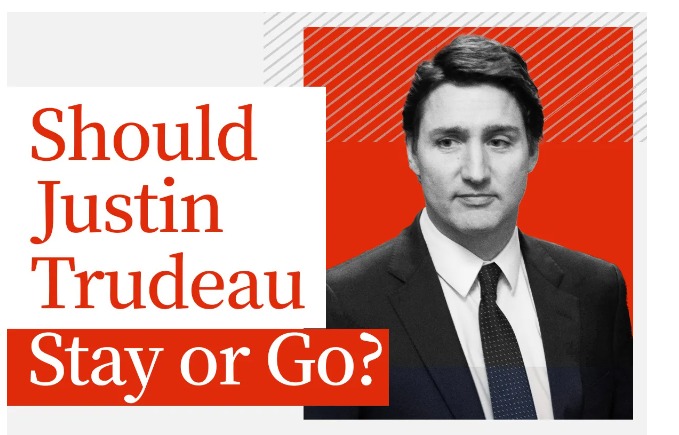
Justin Trudeau has told his closest advisors he would not be true to himself if he quit as Liberal leader and prime minister. He is looking forward to fighting an election against Conservative Leader Pierre Poilievre and believes that with two years until the upcoming election — assuming the Liberal-NDP confidence-and-supply agreement holds — he and his party have enough runway to turn around poll numbers and win a fourth successive general election, a feat achieved only by John A. Macdonald and Wilfrid Laurier.
However, neither Macdonald nor Laurier ever faced an electorate that was so down on the prime minister the way it is on Trudeau.
New polling by Ipsos, provided exclusively to Global News, shows that nearly three in four Canadians believe Trudeau should step down now. Among those who identify as Liberal Party supporters, one in three thinks it’s time for a new party leader.
“I’ve never seen a number that high for a prime minister, probably since Brian Mulroney back in 1991, 1992. And that’s what this really reminds me of,” said Ipsos CEO Darrell Bricker.
“They created the party of Justin Trudeau, and they’re going to live or die by that. They clearly have lived quite well over the course of the last eight years. But the other outcome is the one in which they’re defeated because they’re the party of Justin Trudeau. And that’s where they’re at right now.”
As Trudeau’s popularity goes, so goes the party’s.
Ipsos found that, if an election were held now, 40 percent would vote Conservative, 24 percent would vote Liberal, and 21 percent would vote NDP.
“Still, I know what Jack Layton would do if he was the leader of the party,” Bricker said, “If the NDP passes the Liberals in terms of popular support.
“He clearly wouldn’t support the government, and they would go for it because they see themselves as the progressive alternative, the other option on the ballot for Canadians who have a progressive point of view. But this NDP has not shown that kind of moxie.”
While Jagmeet Singh’s NDP has been critical of Trudeau’s Liberals, they have not given any serious indication that they would unilaterally break the confidence-and-supply deal — a deal in which the minority Liberal government is guaranteed support on matters of confidence by the NDP in exchange for progress on a series of issues the NDP believe should be policy priorities, such as public pharmacare, universal dental care, and housing.
The Liberals are not only at risk of slipping into third place nationally, but they have also dropped to second place in Quebec, where the Bloc Quebecois is the choice of 32 percent of those Ipsos surveyed in that province. The Liberals there are the choice of 28 percent, and the Conservatives are the choice of 22 percent.
Ipsos surveyed 1,000 Canadians using its online panel from Nov. 14 to 17. While a margin of error cannot be calculated from online panels, the pollster says it can measure the reliability of its results using a statistical system known as a credibility interval. Using that system, the pollster says its work is reliable to within 3.8 percentage points, 19 times out of 20.
Bricker says the 16-point Conservative lead isn’t so much the result of any particular affection voters have for Poilievre or the Conservatives as much as it is complete weariness with the Trudeau government and its inability to be seen as effectively managing the issues Canadians care about the most, such as healthcare and housing.
When Ipsos asked respondents which party they believed would be best to handle inflation, fix the housing crisis, manage the economy, and keep taxes down, most respondents picked the Conservatives. On healthcare, poverty, and social inequality, the NDP was the top pick, and on climate change, the Green Party came out on top.
The Liberal Party was not seen as the best to handle any single issue.
And yet Trudeau himself believes another election victory is possible. With Sean Fraser as his new point person on housing, the government is trying to convince Canadians it’s making meaningful changes to housing affordability and supply. That might help boost Liberal numbers. Meanwhile, for the first time since Trudeau became leader of his party a decade ago, the party is running paid negative advertising attacking Poilievre, hoping to drive down Conservative numbers.
Looking at the current polling data, Bricker believes Trudeau’s optimism and confidence is “a very strong take on the current situation.”
Bricker says the only lifeline for the Liberals, given the desire for change among three-quarters of the electorate, is for a major external shock — a Trump re-election perhaps — or a series of major blunders by the Conservative right.
“It would be very unique for notoriety to pull it out of the fire in the situation that he’s in,” Bricker said.
“I mean, even his own party supporters, a significant number of them don’t want him to run again. There’s nothing there. There’s no silver lining that anybody can really latch on to that suggests that there’s any pathway through to solving these problems.”


