


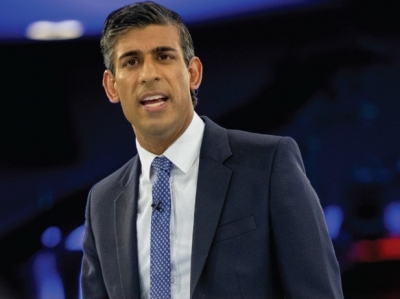
More than democracy’s diversity, it is colonialism’s reverse sweep. The United Kingdom’s Conservative Party, once intricately intertwined with the Empire, imperialism, and British national identity, had contenders from former colonies in Asia and Africa fight to lead it after Boris Johnson stepped down. And after an abortive first try, the son of Indian-descent immigrants from British East Africa finally made it to its top, to become the country’s first Asian Prime Minister.
Rishi Sunak, UK’s former Chancellor of the Exchequer, or Finance Minister, whose unforeseen abdication set in stir the circumstances that forced an intransigent Johnson to eventually bow out before this time, was originally leading in the race to be his successor.
The race had a ethnically different list of campaigners– British Pakistani ministers Sajid Javid and Rehman Chishti, Sunak’s Iraqi Kurd- born successor Nadhim Zahawi, Attorney General Suella Braverman, whose family’s roots are in Goa, and Nigerian- origin former minister Kemi Badenoch. Sunak and Braverman’s fellow Indian- origin Priti Patel, the Home Secretary, chose to sit it out.
Javid and Chishti failed to get enough traction to indeed figure in the race, Zahawi bowed out after the first round, and Braverman after the alternate, leaving Sunak and Badenoch to contend against Trade Minister Penny Mordaunt, Foreign Secretary Liz Truss, and Tom Tugendhat, the backbench MP, who happens to be partial- French. Eventually, Sunak and Truss were the final contenders and she won after the race went to Conservative members across the country.
still, the Truss government soon collapsed- and emigrants were behind its After she removed Chancellor of Exchequer Kwasi Kwarteng( born to Ghanian emigrants), Home Secretary Braverman latterly abnegated, with an excoriating- however half- veiled- attack on the Prime Minister. Truss chose to call it quits and while Johnson was seriously contending to run again, he abstain and Sunak, who was the foremost contender, rode it through to crop triumphant eventually.
A relative freshman- he only came an MP in 2015, Sunak has emphasized that the identity of a person born in the UK but with origins away matters to him. Suave, effective, but also contestation-ridden, the former US- a grounded investment banker, barricade fund driver, and three-time MP has come the first-ethnic Briton to come Prime Minister.
This, however, won’t be entirely unusual– for similar loyal British PMs as Winston Churchill and Harold Macmillan happed to be partial- American( on their mater’s side) and Johnson himself was born in the US, getting the first non-UK-born Prime Minister since Andrew Bonar Law nearly a century agone
( Bonar Law, still, was born in Canada, which was a part of the Conglomerate.)
Born in Southampton on May 12, 1980, Sunak is the son of( the also British) Kenya- born Yashvir Sunak and his woman, Tanganyika- born Usha, whose grandparents were born in the Punjab Province of British India, and migrated to East Africa, and from there to the UK in the 1960s.
” My parents emigrated then, so you’ve got this generation of people who are born then, their parents weren’t born then, and they have come to this country to make a life,” he said in an interview with the BBC in 2019.
” In terms of artistic parenting, I’d be at the tabernacle at the weekend– I am a Hindu– but I’d also be at( Southampton Football Club) the Saints game as well on a Saturday– you do everything, you do both,” he said, also revealing that he was fortunate not to have endured a lot of racism growing up, save for one incident, when he was with his youngish siblings.
With his father a general guru, and his mama, a druggist, he’d an easy nonage. He studied at a fix academy in Hampshire, and also he was at the prestigious Winchester College, where he was top boy and editor of the academy paper; during recesses, he worked at an original curry eatery.
Oxford was the coming stop and he graduated in 2001. The same time, he was canvassed along with his parents for the BBC talkie” Middle Classes Their Rise and Sprawl”. He was a critic at investment bank Goldman Sachs till 2004, and also a barricade fund operation establishment till 2009 when he left to join former associates at a new barricade fund launched in October 2010.
In 2009, he married Akshata, son of Infosys authorN.R. Narayana Murthy and pen Sudha Murthy, who is also the speaker of the Infosys Foundation. Sunak and Akshata have two daughters.
Engaged with the Conservative Party since his Oxford days, Sunak got into politics full-time in 2014 when was named for the Richmond seat in north Yorkshire– one of the safest Conservative seats, which has been held by the party for further than a century– and won it in the 2015 choices by nearly,000 votes.
He retained it in 2017, and 2019 choices, with increased majorities. His precursor as Richmond MP was William Hague, now Baron Hague of Richmond, who held important press positions, Including Foreign Secretary, and was Leader of the House of Commons,
A loyal exponent of” Leave” in the Brexit vote of 2016 and posterior administrative votes, Sunak’s first government job was as Administrative Under- Secretary of State for Original Government( 2018- 19) in the Theresa May government and also as Chief Secretary to the Treasury( 2019- 20) in the government of Johnson, whose leadership shot he’d supported.
He replaced his master Javid as Chancellor of the Exchequer in 2020, and while he substantially earned cheer for steering the government’s profitable response to the goods of the Covid- 19 lockdown, he also came the first Chancellor to be set up to have broken the law while in office by violating lockdown morals.
His woman’s soon-domicile status, which let her save huge quantities of levies in the country, had also come a major contestation. Still, these will be seen as minor interruptions on his path to the top.


