


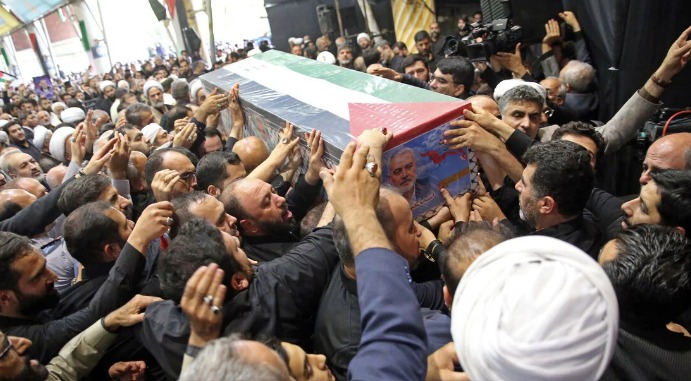
Hamas leader Ismail Haniyeh was buried in Qatar on Friday following his assassination in Tehran, an attack attributed to Israel that has escalated regional tensions amid the ongoing Gaza war. Haniyeh was interred in Lusail, north of Doha, after a funeral at the Gulf emirate’s largest mosque, which was attended by thousands.
Haniyeh, the political chief of the Palestinian armed group, was instrumental in mediating talks to end nearly 10 months of conflict between Hamas and Israel in the Gaza Strip. His burial was attended by a small group, including his daughter Sara, who posted a video on social media of her pouring holy water over his grave and kissing it. “In this moment, I buried my soul under the dirt and I departed. I departed with all the pain of the world in my ribs,” she captioned the video on X.
Earlier on Friday, mourners gathered at the Imam Muhammad bin Abdul Wahhab Mosque, where Haniyeh’s casket, draped in a Palestinian flag, was carried briefly amidst shouts of anger. Many prayed outside in the 44 degrees Celsius (111 degrees Fahrenheit) heat. “He was a symbol, a resistance leader… people are angry,” said Taher Adel, a 25-year-old Jordanian student in Doha.
Khaled Meshaal, Haniyeh’s predecessor, spoke at the ceremony, commending Haniyeh for his dedication to his cause and people. Turkey and Pakistan declared a day of mourning, and Hamas called for a “day of furious rage.”
Haniyeh and a bodyguard were killed in a pre-dawn attack on their accommodation in Tehran on Wednesday, according to Iran’s Revolutionary Guards. Haniyeh had been in Iran for President Masoud Pezeshkian’s swearing-in. Israel, blamed by Hamas, Iran, and others, has not commented on the attack.
The assassination is part of a series of incidents heightening regional tensions during the Gaza war, which has involved Iran-backed groups in Syria, Lebanon, Iraq, and Yemen. Iranian officials met with these groups on Wednesday to plan a response, either jointly or staggered, according to a source close to Lebanon’s Hezbollah.
Israeli Defence Minister Yoav Gallant, in a meeting with British counterpart John Healey, emphasized the need for a coalition to support Israel’s defense against Iran and its proxies. Military chief Herzi Halevi assured troops of a strong response to any attacks. France advised its nationals to leave Iran due to the risk of military escalation.
In Gaza, clashes between Hezbollah and Israeli forces have been frequent. On Friday, the civil defense agency reported casualties in the north, while Israel’s military stated it had killed around 30 operatives near Rafah in the south.
Haniyeh’s death came after Israel’s strike on Beirut killed Fuad Shukr, a military commander of Hezbollah. Earlier this year, Haniyeh’s deputy, Saleh al-Aruri, was also killed in Beirut. Israel recently confirmed the death of Hamas military chief Mohammed Deif in a July strike in Gaza.
Israel has committed to destroying Hamas following the group’s October 7 attack, which resulted in 1,197 deaths and the capture of 251 hostages, 111 of whom remain captive in Gaza, including 39 presumed dead. The retaliatory campaign has caused over 39,480 deaths in Gaza, according to the Hamas-run health ministry, exacerbating a humanitarian crisis. The UN Satellite Centre reported extensive damage to Gaza’s infrastructure.
Iran’s supreme leader Ayatollah Ali Khamenei led prayers for Haniyeh in Tehran and threatened harsh punishment for his killing. The New York Times reported that Haniyeh was killed by an explosive device planted weeks earlier at a Tehran guesthouse. Israeli military spokesman Daniel Hagari denied any other Israeli aerial attacks on the night of Shukr’s killing. Hezbollah vowed retaliation for Shukr’s assassination.
Analyst Hugh Lovatt noted that Haniyeh’s killing eliminates any chance of a ceasefire deal with Israel. US President Joe Biden, in a conversation with Israeli Prime Minister Benjamin Netanyahu, reaffirmed his commitment to Israel’s security against threats from Iran.


