


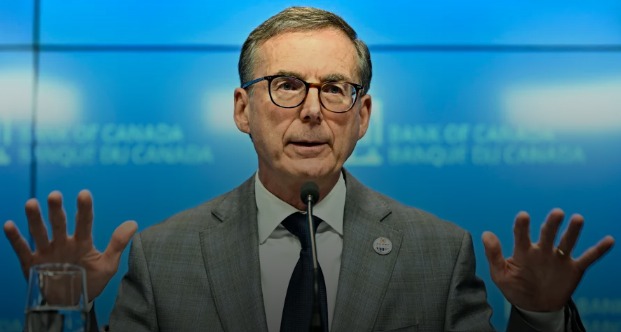
The Bank of Canada has reduced its benchmark interest rate by a quarter of a percentage point, now standing at 4.5 per cent, as Governor Tiff Macklem indicated that further cuts might be necessary to stimulate the economy. This move was widely anticipated by economists due to cooling inflation and signs of economic weakness.
Governor Macklem expressed confidence that the measures to bring inflation back to target are effective, predicting a continued slowdown in inflation and an uptick in economic growth in the second half of the year. Future rate decisions will depend on the latest economic data and the Bank’s inflation outlook. “If inflation continues to ease broadly in line with our forecast, it is reasonable to expect further cuts in our policy interest rate,” Macklem stated. However, he emphasized that the central bank is not on a predetermined path, taking decisions one meeting at a time due to persistent risks that could push inflation higher.
CIBC chief economist Avery Shenfeld noted that the Bank of Canada’s message suggests room for more interest rate cuts, possibly in September, with another cut anticipated in October, bringing the policy rate to 4.0 per cent. BMO chief economist Doug Porter echoed this sentiment, expecting two more cuts this year, contingent on inflation data and job market conditions.
Money markets predict one more 25-basis-point cut this year, with a 53 per cent chance of a cut in the next monetary policy decision on September 4, according to Reuters.
The rate cut, the second in as many months, will impact Canadians with variable-rate debt, such as some mortgages and home equity lines of credit. Many Canadians, facing mounting debt costs, have been calling for relief, with recent polling indicating that 66 per cent “desperately” needed another interest rate cut.
Macklem acknowledged the financial strain on households, stating that lower interest rates would provide some relief by reducing debt costs, allowing Canadians more disposable income for other expenses. The Bank of Canada began its interest rate easing cycle in June with a 25-basis-point cut. Since March 2022, elevated interest rates have increased borrowing costs for many, aiming to cool high inflation levels. However, the central bank’s recent communications have shifted focus towards avoiding economic downturns, giving more weight to downside risks.
Tu Nguyen, an economist with RSM Canada, highlighted the Bank of Canada’s change in tone from hawkish to dovish, indicating confidence in reducing price pressures while avoiding severe economic outcomes. Nguyen predicts that inflation will reach the target of two per cent by 2025, barring any surprises.
Macklem emphasized the importance of economic growth to prevent inflation from falling too low, maintaining the central bank’s symmetric inflation targeting framework. Despite inflation cooling to 2.7 per cent in June, the Bank of Canada revised its year-end inflation forecast to 2.4 per cent, up from April’s prediction of 2.2 per cent. By the end of 2025 and 2026, inflation is expected to hit the two per cent target.
While acknowledging potential setbacks, Macklem noted that inflation remains high in the shelter component, with rising rents and mortgage costs. Wage growth, although still elevated, is showing signs of easing. Macklem stated that while interest rates need to stay “restrictive,” they don’t need to be as tight as before to maintain the cooling trajectory of inflation.
Following weaker-than-expected growth in the first quarter, the Bank of Canada anticipates a rebound in the third quarter, forecasting real GDP growth at an annualized rate of 2.8 per cent, up from the second quarter’s 1.5 per cent expectations.


