


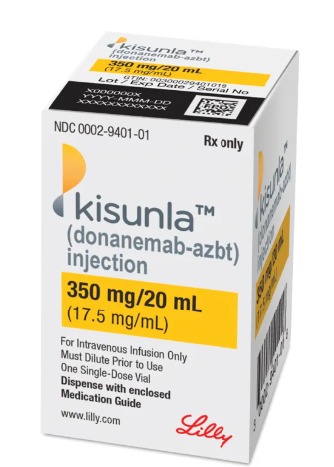
On Tuesday, the U.S. Food and Drug Administration approved Eli Lilly’s treatment for early Alzheimer’s, making it the second therapy available to U.S. patients that slows the progression of the brain-wasting disease. The drug, donanemab, will be marketed under the brand name Kisunla. The FDA’s decision aligns with recommendations from the agency’s external experts, who unanimously supported the drug’s use in patients with early Alzheimer’s disease, citing that the benefits outweigh the risks.
Joanne Pike of the Alzheimer’s Association commented, “This is real progress. Having multiple treatment options is the kind of advancement we’ve all been waiting for — all of us who have been touched, even blindsided, by this difficult and devastating disease.”
Donanemab, like Eisai and Biogen’s rival drug Leqembi, which was approved a year ago, targets the Alzheimer’s-related protein beta amyloid to clear it from the brain. A notable feature of donanemab is its finite dosing regimen, allowing patients to discontinue treatment once brain scans show no amyloid plaques.
Eli Lilly has priced Kisunla at $695.65 per vial, or roughly $32,000 for a 12-month treatment consisting of 13 infusions. This is slightly higher than Eisai’s Leqembi, which costs $26,500 annually. BMO analyst Evan Seigerman noted that the pricing reflects the finite nature of donanemab’s treatment compared to the chronic treatment required with Leqembi.
Dr. Erik Musiek, a neurologist at Washington University’s Barnes-Jewish Hospital, said, “The details of how it will play out in clinical practice are still unclear, but I think it will save a lot of money and patients will like that a lot better. I think that, coupled with the monthly dosing, will make this an attractive option.”
In Eli Lilly’s large, late-stage trial, donanemab slowed the progression of memory and cognitive problems by 29% compared to a placebo. However, the drug also caused brain swelling in nearly a quarter of patients and brain bleeding in nearly a third, although most cases were mild. The FDA has placed its strongest “boxed” safety warning on donanemab’s prescribing label, highlighting the risks of potentially dangerous brain swelling and bleeding.
One key difference between donanemab and Leqembi is the monitoring requirement: donanemab will need five MRI scans to check for side effects, while Leqembi requires four. This could give Leqembi an advantage in centers where MRI scans are scarce, according to RBC Capital analyst Brian Abrahams. Eisai and Biogen are also working on submitting data to the FDA to support approval of a monthly maintenance dose and a weekly injected version of Leqembi that could be administered at home.
Lilly’s drug is expected to be used primarily by patients enrolled in the U.S. government’s Medicare health plan for people aged 65 and older. Medicare began covering Alzheimer’s drugs that receive standard FDA approval last year.
Morningstar analyst Damien Conover predicts that Lilly’s drug could generate peak annual sales of over $5 billion and that the market will be fairly evenly split between donanemab and Biogen’s Leqembi.
According to the Alzheimer’s Association, more than six million Americans have Alzheimer’s disease.


