


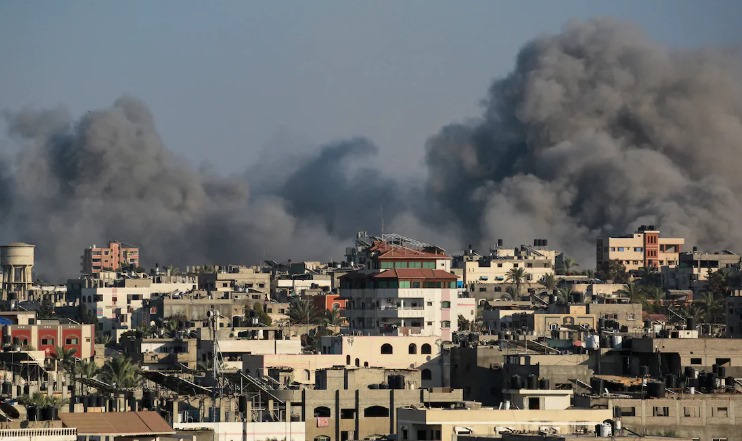
Israel’s military campaign in Gaza, which began following the deadly October 7 attack last year that claimed over 1,100 lives, has now entered its 10th month, with the death toll surpassing 40,000. As the violence in the Gaza Strip continues, Israel has opened another front in the West Bank, a separate Palestinian territory, where a large-scale military operation has been ongoing for two days, resulting in at least 16 deaths.
As Israel’s prolonged “war” continues, attention has turned to its extensive use of artificial intelligence (AI) tools in the bombing campaign in Gaza. These tools, with names like ‘Gospel,’ ‘Alchemist,’ ‘The Death of Wisdom,’ and ‘Lavender,’ have been employed to process vast amounts of data, identify suspects linked to Hamas and Palestinian Islamic Jihad (PIJ), and target them for strikes.
Lavender and Its Use
Developed by Israel’s elite intelligence unit, Unit 8200, Lavender is an AI-powered database designed to identify potential targets connected to Hamas and PIJ. Using machine learning algorithms, Lavender processes large volumes of data to pinpoint individuals categorized as “junior” militants within these groups. Initially, Lavender identified approximately 37,000 Palestinian men associated with these organizations.
The use of AI to identify targets marks a significant shift from traditional methods used by Israel’s intelligence agencies, Mossad and Shin Bet, which relied more on human decision-making. Soldiers had as little as 20 seconds to determine whether to strike a target identified by Lavender, often relying on the AI’s information without question, despite the program’s error margin of up to 10 percent. Reports indicate that many of the targets identified by Lavender had minimal or no affiliation with Hamas.
Gospel – Israel’s Other AI Tool
Another AI system, known as “Gospel,” is used to rapidly produce targets based on intelligence data. The Israeli Defense Forces (IDF) stated that Gospel improves the accuracy and quality of intelligence by automatically extracting updated information to recommend targets for researchers. The goal is to ensure a complete match between the machine’s recommendation and human verification.
These AI platforms not only select targets for airstrikes but also enable the rapid assembly of raids using another AI model called Fire Factory. This model calculates munition loads, prioritizes and assigns thousands of targets to aircraft and drones, and proposes a strike schedule.
A report by +972 Magazine references the book The Human-Machine Team: How to Create Synergy Between Human and Artificial Intelligence That Will Revolutionize Our World, authored by “Brigadier General YS,” reportedly the commander of Unit 8200. The book advocates for the use of AI in “deep defense” to identify and strike the right targets at the right time, minimizing collateral damage.
In the chapter “Deep Defense: New Potentials,” the author discusses the concept of “deep defense,” which involves using the Human-Machine Team to address security challenges in unprecedented ways. The goal is to enable the identification of tens of thousands of targets before conflicts and to continue identifying thousands of targets daily during military operations. The author argues that such tools are essential for the military to conduct precise strikes with reduced collateral damage.


