


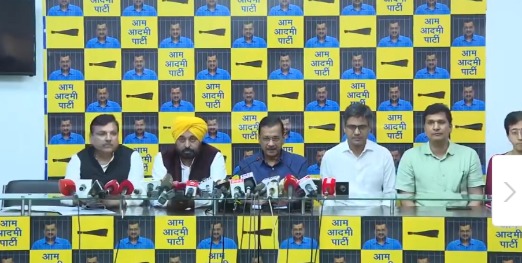
New Delhi: In a significant development in the country’s jurisprudence, the Enforcement Directorate has, for the first time, named a political party as an accused in a case in New Delhi. A supplementary chargesheet filed in the Rouse Avenue court on Friday in the alleged liquor policy scam has named the Aam Aadmi Party (AAP), a national political party, and its national convenor, Arvind Kejriwal, who is currently out on interim bail in the case. The agency is investigating the money laundering angle of the alleged scam. This marks the eighth chargesheet filed in the case by the agency, but it is the first to include the Delhi chief minister as a named individual. Mr. Kejriwal was arrested on March 21, becoming the third senior AAP leader to be taken into custody in connection with the alleged scam, following his former deputy Manish Sisodia and Rajya Sabha MP Sanjay Singh.
Sources suggest that the decision to name the AAP as an accused could have significant repercussions for the party. The Enforcement Directorate now has the option to write to the Election Commission of India to initiate the process of derecognizing the Aam Aadmi Party. Additionally, it can pursue the attachment of the party’s assets, including its headquarters in Delhi.
This development comes amidst a controversy involving the AAP’s Rajya Sabha MP, Swati Maliwal, who has alleged that she was assaulted by Mr. Kejriwal’s aide, Bibhav Kumar, at the chief minister’s residence. The allegations have sparked a political storm, with the AAP facing criticism from various quarters, including Finance Minister Nirmala Sitharaman. An alleged video from the incident has further fueled the controversy, leading to exchanges of accusations between Ms. Maliwal and the AAP.
Earlier on Friday, a Delhi Police team, accompanied by forensic specialists, had visited Mr. Kejriwal’s residence to investigate Ms. Maliwal’s complaint.
The Supreme Court had raised the question of naming the AAP as an accused in October last year, querying why the party had not been implicated if it had purportedly benefited from the alleged kickbacks in the liquor policy case. However, the court clarified that its query was not intended to implicate any political party but was merely a legal question.
Recently, while rejecting a challenge to Mr. Kejriwal’s arrest, a Delhi High Court bench held that a political party can be brought within the purview of the Prevention of Money Laundering Act, 2002. The court cited the definition of ‘political party’ under Section 2(f) of the Representation of Peoples Act, which includes an ‘association or body of individuals’, and noted that under Explanation 1 of Section 70 of the PMLA, a ‘company’ also encompasses an ‘association of individuals’.


