


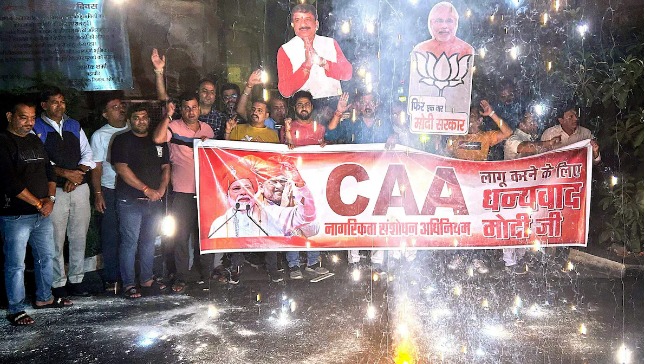
The Ministry of Home Affairs (MHA) announced on Wednesday that helpline numbers will soon be launched to assist applicants for Indian citizenship under the Citizenship (Amendment) Act, 2019 (CAA-2019). According to the MHA, applicants will be able to obtain information related to CAA-2019 by calling toll-free from anywhere in India. The service will be available from 8 am to 8 pm.
“Helpline numbers to assist applicants for Indian citizenship under CAA-2019 will be launched soon. Applicants will be able to obtain information related to CAA-2019 by calling toll-free from anywhere in India. The service will be available from 8 am to 8 pm,” MHA posted.
On Monday, the MHA announced CAA Rules, 2024, removing legal barriers to citizenship for such individuals and aiming to provide a dignified life to refugees who have suffered for decades.
Earlier, the MHA launched a web portal through which eligible non-Muslim migrants from Bangladesh, Pakistan, and Afghanistan fleeing religious persecution can now apply for Indian citizenship.
A mobile app named ‘CAA-2019’ will also be launched very soon to facilitate applications through mobile devices.
Currently, individuals persecuted from Afghanistan, Pakistan, and Bangladesh on religious grounds belonging to six minority communities – Hindus, Sikhs, Buddhists, Jains, Parsis, and Christians – can apply for the grant of Indian citizenship through the portal indiancitizenshiponline.nic.in.
The portal was made available on Monday night after the MHA announced the rules under the Citizenship (Amendment) Act, 2019 (CAA-2019), now referred to as the Citizenship (Amendment) Rules, 2024. These rules grant Indian citizenship to refugees who sought shelter in India before December 31, 2014.
This dedicated portal allows individuals persecuted from Afghanistan, Pakistan, and Bangladesh on religious grounds to apply for Indian citizenship. All six minority communities – Hindus, Sikhs, Buddhists, Jains, Parsis, and Christians – persecuted in these three countries, who sought refuge in India before December 31, 2014, can submit applications entirely online through the portal named “Indian Citizenship Online Portal.”
An application must be submitted to a designated committee through the District Level Committee led by a designated officer. All documents along with photographs are to be uploaded online, and the applications will be processed after a background check by security agencies.
As the CAA is for undocumented individuals from the six communities, a set of documents including those issued by government authorities in Pakistan, Afghanistan, and Bangladesh must be uploaded by CAA applicants to obtain citizenship.
According to the rules, the applicant must appear in person to subscribe to the application and take the oath of allegiance. Failure to do so may result in the district-level committee recommending denial.
Applicants must provide an “eligibility certificate” issued by a “locally reputable community institution” confirming that they belong to the “Hindu, Sikh, Buddhist, Jain, Parsi, and Christian community and continue to be a part of the above-mentioned community.
The online application process offers various categories under which an applicant can seek Indian citizenship. These include: (i) a person of Indian origin (ii) a person married to a citizen of India (iii) a minor child of an Indian citizen (iv) a person whose parents are Indian citizens (v) a person who or either of parents was a citizen of Free India (vi) a person registered as Overseas Citizen of India Cardholder (vii) a person seeking citizenship by naturalization – an adult registered as overseas citizen of India for five years, and who has been residing in India for a year.
The applicant can submit any of the following documents while applying for Indian citizenship under CAA: (i) a copy of a passport issued by the Afghanistan, Bangladesh, or Pakistan governments (ii) a birth certificate issued by a government authority in these countries (iii) educational certificate from a school/university/board or college in Afghanistan, Bangladesh, or Pakistan (iv) identity document of any kind issued by government authorities in these countries (v) residence permit issued by Foreigners Regional Registration Officer or Foreigners Registration Officer in India (vi) any license issued by government authorities in these three countries (vii) land or tenure records in these countries (viii).
Any document showing that either of the parents or grandparents or great-grandparents of the applicant is or had been a citizen of these countries. In effect, any document issued by a government authority in Afghanistan, Bangladesh, or Pakistan to establish that the applicant is from either of these countries is valid for the citizenship process. This applies even if the document is beyond its validity period.


