

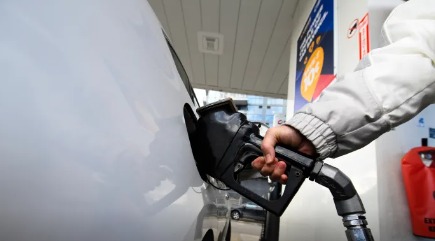
A sharp increase in gas prices is causing frustration among drivers in certain parts of Canada on Thursday.
Many drivers filling up at the pumps are facing higher costs — some up by as much as 22 cents compared to last week in parts of Ontario, for example.
Data from GasBuddy’s live gas price tracker shows that prices were 10.9 cents higher on average across Ontario, reaching $1.73 per liter by 4 p.m. Eastern on Thursday, compared to the previous day’s average.
Gas prices rose by a similar degree in Toronto, but in southwest Ontario towns such as Sarnia, GasBuddy reports that the cost of gasoline has surged by 22.3 cents to $1.79 per liter as of 4 p.m. Other Ontario regions near the U.S. border, such as Chatham and Windsor, also experienced double-digit increases in gas prices.
Ontario Premier Doug Ford expressed his frustration about the rise in gas prices on Thursday. Analysts had predicted prices would rise overnight due to the transition to summer gasoline blends from winter fuel.
“You go out last night and you’re sitting there for 20 minutes in the lineup to get gas, you know, and it’s disappointing. Everywhere I was going, it was about a buck fifty-nine. You wake up this morning and it’s $1.80. You know, it’s completely disgusting,” Ford said during an appearance in Oakville, Ont.
Quebec drivers were also experiencing price hikes on Thursday, with an increase of 7.5 cents pushing the province’s average cost past $1.80 a liter, according to gas data. Gas prices in Montreal reached an average of $1.88 per liter by 4 p.m., an 8.9-cent increase from Wednesday.
“Of course, it will have an impact on our budget. So for ordinary people, regular folks, families, it’s going to be tough,” Montreal Mayor Valérie Plante said on Wednesday ahead of the price surge.
Gas prices in British Columbia were creeping towards the $2 per liter mark, rising 1.4 cents to an average of $1.95 as of 4 p.m. Eastern.
Prices were also slightly higher in Newfoundland and Labrador and New Brunswick on Thursday but remained generally steady in the other Atlantic regions and in the Prairies.
Dan McTeague, president of Canadians for Affordable Energy, told Global News that Western Canada and some U.S. markets switched from winter to summer gasoline about a month ago. Those regions are linked to the Chicago wholesale prices, while most of Ontario’s prices are tied to what happens in the New York Harbor, which switched to the summer blend on April 16, he said.
Winter gas is cheaper than summer blends because it contains higher levels of butane — an inexpensive but volatile component that lowers the cost of fuel, Patrick de Haan, head of petroleum analysis.
The cost of producing summer gas is higher because butane levels are reduced to meet Canadian environmental regulations and lower emissions.
Where do gas prices go from here?
On a national basis, the price of gas averaged $1.74 per liter as of 4 p.m. Eastern. That’s up 6.5 cents from Wednesday and 18.7 cents higher than the average in March.
De Haan said Thursday that pump prices are expected to decrease in July.
McTeague told Global News that where gas prices go from here depends in part on instability in the Middle East, where attacks on any given day can send shocks into the global price of oil.
He said it’s unlikely for Ontario to hit $2/liter this summer, but those prices may be possible in Quebec. In much of Western Canada, “what you see is what you get,” with prices expected to remain around current levels, he said.
But for those who missed out on fueling up before the overnight spike, McTeague also predicted gas prices would drop back another five cents in Ontario and Quebec on Friday.
Statistics Canada cited higher gas prices as fueling a slight uptick in inflation last month, which accelerated to 2.9 percent annually from 2.8 percent in February. Prices were rising at a faster rate in Western Canada in March, StatCan noted.
Higher global crude oil prices are attributed to geopolitical conflicts hampering production, the agency said earlier this week.
De Haan told earlier this month that geopolitical conflicts like Russia’s war on Ukraine, more expensive summer gas, increased demand for summer travel, and maintenance at refineries would keep prices elevated.
“It’s becoming more evident that with each year’s increase, it’s becoming less and less likely that we would see a sub-dollar-a-litre price,” told De Haan
Canada’s carbon price also increased earlier this month, rising $15 to $80 a ton in regions that have adopted the federal program. The increase was expected to add about three cents to the cost of gasoline for Canadians.
This past Monday, some Canadians living in areas with the federal carbon price received the first quarterly rebate tied to the program.